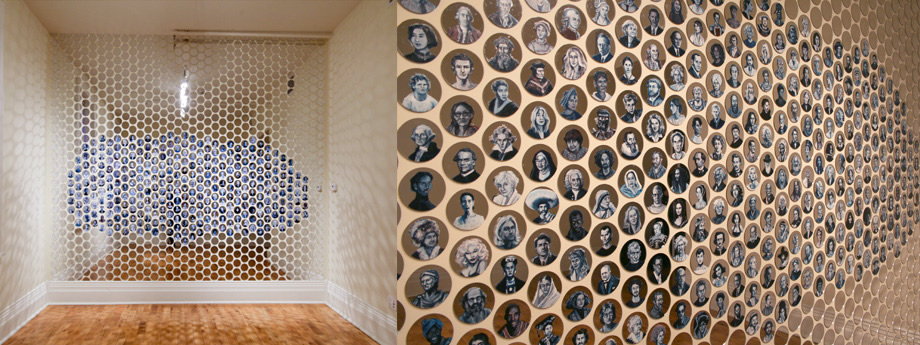
Photo left: Agata and Lucas Piskunowicz, photo right: Gareth Bate, 2012.
Jewel Net of Indra
Artist Statement and Names List
Gareth Bate
View Installation
Return to Writing Menu
View List of Names
"Could a greater miracle take place than for us to look through each other's eyes for an instant? We should live in all the ages of the world in an hour; ay, in all the worlds of the ages. History, Poetry, Mythology! - I know of no reading of another 's experience so startling and informing as this would be." Henry David Thoreau in Walden.
My Jewel Net of Indra is an ongoing painting-based installation that will take at least 5 years to complete. It is a cosmology representing the interconnectedness of humanity. The starting point is a Mahayana Buddhist metaphor of an infinite net of jewels, each representing an individual. Every jewel contains a reflection of all others. The installation attempts to represent the totality of lives lived. It is "everyone." I am interpreting the metaphor as a meditation on the possibilities of life, and our relationships to the individuals who shape history. It is about self-reflection. The installation is an image of an idea of the self. Do we construct our self-image out of the stories of these people? Are we the accumulation of them? Who are they? What lives did they live? What choices did they make? How do they interconnect and influence each other? What aspects of them are within us?
Phase 1 of Jewel Net of Indra began as a small wall installation with over one thousand acrylic mirrored discs laser cut to the size of my palm. The images featured on the website represent the 325 people of Phase 1 which were exhibited at Toronto's Gladstone Hotel. For phase 2 I have now completed around 1900 people with the ultimate goal being 6765. The latest version won't be exhibited for years. Because they now fill an entire room you can see the infinite reflection aspect that didn't happen in the original installation. The mirrors contain hand-painted miniature portraits of iconic individuals of history. The accumulation of discs fragments the viewers as they move through the empty room. The negative space creates the net. The installation contains three perspectives; atomic, personal and cosmic. Each person is a tiny atom in the whole, yet they are all individually painted in a very humanistic way. The overall accumulation creates a cosmos. In an era defined by apocalyptic thinking, this room is a place to stop and take stock of where we’ve been, and how we got here. Gareth can usually complete 5 to 8 portraits a day while painting on average 7 to 8 hours. In time the piece will grow into an enormous immersive room installation where the mirrors all reflect each other. In Phase 1 the portraits were arranged randomly, in Phase 2 they will be arranged in chronological thematic layers where every person is connected to the people around them.
Gareth chose to paint iconic individuals who all have well-known stories. This highly idiosyncratic mix of people were chosen to represent a cross-section of humanity throughout time. Each person has either had an influence on human history or ideas, or led a compelling or tragic life. Each face acts as a trigger for a story. These relationships form an elaborate puzzle for the viewer to decipher. The portraits are drawn from photographs, sculptures and paintings throughout history. It is not essential to recognize all the faces, that is impossible. It is enough to know these people are present in the work. The piece attempts to collect and catalogue them all, to reveal all the major figures that shaped the world as we know it.
The piece is feminist. There are an equal amount of men and women. Considerable effort was made to find people of a wide range of backgrounds from all over the world. Every person has been chosen for a reason. There are also deliberate omissions! There are philosophers, artists, writers, musicians, singers, poets, politicians, rebels, kings and queens, tyrants, scientists, activists, journalists, doctors and nurses, soldiers, popes and cult leaders, celebrities, athletes, heroes, terrorists and freedom fighters, freaks, slaves, mobsters, thieves, murderers and victims, or even iconic muses from a works of art. Although a list of names is included, the faces are not identified. The piece depends on an individual’s engagement with history, and the preservation of knowledge. Otherwise these people simply become anonymous. The more the portraits accumulate, the more insignificant each person becomes. The presence of serial killers and horrible tyrants is crucial to the piece. This is not about heroes it is about humans.
The act of painting is essential to the piece. It becomes a ritual, a repetitive action. In a sense Gareth has become like a monk transcribing a Bible day after day in his monastery. It is labour intensive, but never boring. Each portrait is different, and a unique challenge. The work involves spending time with each person in an intimate way. Each one requires its own approach. Gareth hopes to capture their essence, so that they feel alive. While painting, his eyes constantly shift between the person being depicted and his own reflection. Gareth found that painting their portraits made these people feel less inaccessible. The act of painting transforms him into them. There is something special about the moment when a portrait is completed and he can metaphorically place them into the whole.
The installation would be impossible to create without the Internet. Interestingly, the metaphor of Indra’s Net has been applied to the interconnectedness of the web. Gareth has spent hundreds of hours researching online for portraits and stories as well as visiting museums, scouring bookstores and reading biographies and travel books. Especially useful, are websites devoted to extensive lists of famous people and events. The process involves sitting at his studio desk painting from an image on a laptop, while simultaneously listening to lectures from the Learning Company. This remarkable series of university lectures called “The Great Courses” covers a wide range of topics. Thus, the process is about engaging with history, philosophy, science and art.
Life has so many possibilities and choices. Why does someone in one time act in the most evil way, while another rises to a heroic position? Are we free to choose? Despite their relative fame or infamy, power or powerlessness, there is an essential equality to all of these people. Each represents just one brief human life.
"You use a glass mirror to see your face, you use works of art to see your soul." George Bernard Shaw.
Special Thanks: Graham Jackson, Dawne Rudman, Marina Guglielmi, Carolyn Dinsmore, Stanzie Tooth, Deborah Wang and Britt Welter-Nolan.
Dates: August 2011 - Present.
Medium: Acrylic mirrors with acrylic painted portraits.
Exhibitions: Jewel Net of Indra (Phase 1), Come Up To My Room, The Gladstone Hotel, Toronto, Jan. 27 - 29, 2012
Press: Interviewed for the Toronto Standard and featured on the CBC, Radio Canada, Toronto Life, View on Canadian Art, Torontoist, Design Lines, Fashion Magazine, MOCO, and Display Design Magazine. View Press Section
1555 Names
* Indicates Phase 1 is the 325 people painted from Sept. 2011 to Jan. 2012 for Come Up To My Room. Phase 2 is the 1229 people painted so far after Jan. 2012 and not yet exhibited.
54 names have not yet been added to this list. The total completed so far is 1600.
A
Abbas I of Persia
Esraa Abdel Fattah
Tarab Abdul Hadi
Abdul Hamid II
Marina Abramović
Ansel Adams
Maude Adams
Samuel Adams
Joy Adamson
Jane Addams
Alfred Adler
Hilma af Klint
Michel Aflaq
Agrippina the Elder
Marcus Vipsanius Agrippa
Anouk Aimée
Ai Weiwei *
Akbar the Great
Anna Akhmatova
Pharoah Akhenaten *
Alaric the Goth
Anwar al-Awlaki
Bashar al-Assad
Hafez al-Assad
Madeleine Albright
Louisa May Alcott
Alcibiades
Alexei Nikolaevich Tsarevich of Russia
Alexander III of Macedon *
Pope Alexander VI
Al-Farabi
Haj Amin al-Husseini
Ayaan Hirsi Ali *
Muhammad Ali *
Alice
Soong Ai-ling
Leon Battista Albderti
Iman Al-Ghazali
Imam Ali
Dante Alighieri
Rafed al Janabi
Gregorio Allegri *
Gracie Allen
Woody Allen *
Isabel Allende
Salvador Allende
Alvin Alley
Muhammad Ahmad Al-Mahdi
Nayirah al-Sabah
Bindo Altoviti
B. R. Ambedkar
Amenhotep
Amenhotep III
Idi Amin Dada
Qasim Amin
Yigal Amir
Mata Amritanandamayi
Hans Christian Andersen
Anna Anderson
Laurie Anderson
Marian Anderson
Björn Andrésen
Ursula Andress
Julie Andrews
Princess Angeline
Maya Angelou *
Kofi Annan *
Antinous *
Susan B. Anthony *
Anna Mae Aquash
Anne, Queen of Great Britain
Thomas Aquinas *
Yasser Arafat
Maher Arar
Louise Arbour
Diane Arbus
Giuseppe Arcimboldo
Archimedes
Jann Arden
Reinaldo Arenas
Hannah Arendt
Aristotle *
Joan Armatrading
Neil Armstrong *
Dorothy Arzner
Emperor Ashoka
Pitseolak Ashoona *
Julian Assange *
Fred Astaire
John Jacob Astor IV
Nancy Astor, (Viscountess Astor)
Atahualpa
Mustafa Kemal Atatürk
Attila the Hun
Margaret Atwood *
Emperor Augustus *
Alice Auma
Emperor Aurangzeb *
Emperor Marcus Aurelius *
Jane Austen *
Virginie Amélie Avegno Gautreau
Avicenna
Jane Avril
Nahlah Ayed
Ayyankali
B
Sarah Baartman *
Delia Bacon
Francis Bacon *
Joan Baez *
Josephine Baker *
Ella Baker
Abu Bakr as-Ṣiddīq (Abdullah ibn Abi Quhafa)
George Balanchine *
James Baldwin *
Robert Bales *
Lucille Ball
Florence Ballard
Africa Bambaataa
Sirimavo Bandarnaike
Karuna Banerjee
Barbara (Monique Andrée Serf)
Djuna Barnes
Bridget Bardot
Ma Barker
Clara Barton *
Jean-Michel Basquiat
Elizabeth Bathory
Charles Baudelaire *
Pina Bausch
Maurice Bavaud
Samuel Beckett
Sister Wendy Beckett *
Ludwig von Beethoven *
Gertrude Bell
Ben Ammi Ben-Israel
Ota Benga *
Ingrid Bergman
Ingmar Bergman
David Ben-Gurion
Walter Benjamin
Isaiah Berlin
Hector Berlioz
Bernadette of Lourdes
Émile Henri Bernard
Paul Bernardo *
Sarah Bernhardt
Vitus Bering
Tim Berners-Lee
Gian Lorenzo Bernini
Leonard Bernstein
Annie Besant
Mary Jane Bethune
Norman Bethune
Joseph Beuys
Benazir Bhutto *
Steve Biko
Hussein bin Ali
Osama bin Laden *
Juliette Binoche
Björk
Blackbeard
Black Elk *
Chief Black Hawk
William Blake
Helena Blavatsky
Karen Blixen
Blondie
Nellie Bly
Boa Sr. (last native of the Andaman Islands)
Umberto Boccioni
Boëthius
Humphrey Bogart
Anne Boleyn *
Simon Bolivar *
Billy the Kid
Napoleon Bonaparte *
Louis-Napoleon III Bonaparte
Costanza Bonarelli
Rosa Bonheur
Andrés Bonifacio
Bono, (Paul David Hewson)
Nana Kwaku Bonsam
John Wilkes Booth
Lizzie Borden *
Cesare Borgia
Gioffre Borgia
Giovanni Borgia
Lucrezia Borgia
Nathaniel Borenstein
Francesco Borromini
Hieronymus Bosch
Sandro Botticelli *
Mohamed Bouazizi *
François Boucher
Louise Bourgeois
Margaret Bourke-White
Edith Bouvier Beale *
Clara Bow
David Bowie
Belle Boyd
Boy George
Susan Boyle
Gian Francesco Poggio Bracciolini
Mark Bradford
Ian Brady
Constantin Brâncuși
Marlon Brando *
Eva Braun
Anders Behring Breivik
Jacques Brel
André Breton
Bridget of Sweden
Ruby Bridges
Sergey Brin
Vera Brittain
Gwendolyn Brooks
Romaine Brooks
Joseph Broussar
Christy Brown
John Brown
Louise Brown
Molly Brown, (The Unsinkable Molly Brown)
Nicole Brown Simpson
Pieter Bruegel the Elder
Filippo Brunelleschi
Giordano Bruno
Marcus Junius Brutus The Younger
Martin Bryant
Yul Brynner
Lü Bu
Grace Budd
James Bulger
Beau Brummell
Gisele Bündchen
Ted Bundy
Chang and Eng Bunker
Luis Buñuel Portolés
Michelangelo Buonarroti *
Edmund Burke
Barnet Burns
George Burns
Allie Mae Burroughs
Jackie Burroughs
Kate Bush
Judith Butler
Julian Byng
Lord Byron
C
Helen Caldicott
Emperer Caligula *
Maria Callas *
William Calley
June Callwood
John Calvin
Caryn Campbell
Naomi Campbell
Jane Campion
Albert Camus
Al Capone
Princess Caraboo (Mary Baker)
Michelangelo Caravaggio *
George Carlin
Emily Carr *
Edward Carpenter
Karen Carpenter
Dora Carrington
Lewis Carroll
Rachel Carson *
Mary Cassatt *
Eva Cassidy
Kevin Carter
Butch Cassidy (Robert Leroy Parker)
Fidel Castro *
Catherine of Alexandria *
Catherine of Aragon
Catherine Parr
Catherine the Great *
Georgiana Cavendish, Duchess of Devonshire
Elena Ceaușescu
Miguel de Cervantes
Aimé Césaire
Paul Cézanne
Marc Chagall
Jean-François Champollion
Charlie Chaplan
Lindy Chamberlain-Creighton
Neville Chamberlain
Subhas Chandra Bose
Coco Chanel *
Iris Chang
Carol Channing
Tracy Chapman
Charlemagne
Mary Eugenia Charles
Geoffrey Chaucer
Cher
Leslie Cheung
Judy Chicago
Andrei Chikatilo
Julia Child
Soong Ching-ling
Shirley Chisholm
Agatha Christie *
Noam Chomsky *
Annabel Chong
Jesus Christ
Winston Churchill *
Huang Chuncai *
Cicero
Tansu Çiller
Emperor Claudius
El Cid, or El Campeador (Rodrigo Díaz de Vivar)
Joseph Cinqué
Conchita Cintrón
Empress Dowager Cixi *
Camille Claudel
José Clemente Orozco
Samuel Langhorne Clemens (Mark Twain) *
Pharaoh Cleopatra VII *
Anne of Cleves
Patsy Cline
Hilary Clinton *
Kurt Cobain *
Jean Cocteau
J.M. Coetzee
Leonard Cohen *
Bessie Coleman
Vince Coleman
Judy Collins *
Pamela Colman Smith
Christopher Columbus
Dorothy Comingore
Captain James Cook
Arthur Conan Doyle
Confucius *
Constantine the Great
Nicolas-Jacques Conté
Whina Cooper
Nicolaus Copernicus, *
Charlotte Corday *
Billy Corgan
Catherine Cornaro
Rachel Corrie *
Maria Cosway
Gustave Courbet
Jacques Cousteau
Hernando Cortez *
Thomas Cranmer
Cindy Crawford
Joan Crawford
Oliver Cromwell *
Thomas Cromwell
Aleister Crowley
Tom Cruise
Suzanne Curchod
Marie Curie *
Pierre Curie
Imogen Cunningham
Merce Cunningham *
George Armstrong Custer *
Cyrus II of Persia
D
Jeffrey Dahmer
Daji
14th Dalai Lama, (Tenzin Gyatso) *
Salvador Dalí
Roméo Dallaire
Joe Dallesandro
Father Damien
Thomas D'Arcy McGee
Charles Darwin *
Jacques Louis David *
Alexandra David-Néel *
Elaine Davidson
Marion Davies
Leonardo da Vinci *
Angela Davis *
Bette Davis *
Miles Davis
Richard Dawkins
Dorothy Day
Moshe Dayan
Lope de Aguirre
James Dean *
Blossom Dearie
Honoré de Balzac
Simone de Beauvoir *
Miguel de Cervantes
Samuel de Champlain
Jay DeFeo
Claude de France
Vasco da Gama
Ellen Degeneres *
F. W. de Klerk
Willem de Kooning
Ferdinand Victor Eugène Delacroix
Bartolomé de las Casas *
Maurice Quentin De La Tour *
Juana Ines de la Cruz
Tamara de Lempicka
Anne-Catherine de Ligniville
Anne-Thérèse de Marguenat de Courcelles
Demasduit (Mary March)
Catherine de Medici *
Giuliano de' Medici
Lorenzo de' Medici Ritratti
Jean Charles de Menezes
Cecil B. De Mille
Judi Dench
Catherine Deneuve
Frances Densmore
Gérard Depardieu
Juan de Pareja
Antoine de Paris
Christine de Pizan
Madaame de Pompadour
Cardinal de Richelieu (Armand Jean du Plessis)
Albert DeSalvo
Lhasa de Sela
Isabella d'Este
Diego de Landa Calderón
Germaine de Staël, (Madame de Staël)
Maria de Sautuola
Jacques Derrida
Jean-Jacques Dessalines *
Indra Devi
Sarada Devi
Cut Nyak Dhien
Serge Diaghilev
Diana Princess of Wales *
Porfirio Diaz
Evelyn Dick
Charles Dickens *
Denis Diderot
Marlene Dietrich
Leila Diniz
Isabelle Dinoire
Diogenes of Sinope
Celine Dion *
Christian Dior
Walt Disney
Divine (Harris Glenn Milstead)
Bernadette Dohrn
Donovan
"Paul" Fustave Doré
Françoise Dorléac
Alfred (Boise) Douglas
Tommy Douglas *
Frederick Douglass *
Alfred Dreyfus
Livia Drusilla
W. E. B. Du Bois
Marcel Duchamp
Robert Dudley, 1st Earl of Leicester
Gaëtan Dugas
Alexandre Dumas
Albrecht Durer *
François Duvalier
Andrea Dworkin
Bob Dylan *
E
Amelia Earhart *
Charles Eastman
Elizabeth Eckford
Thomas Edison
Dame Edna Everage (Barry Humphries)
Adolf Eichmann *
Gustave Eiffel
Albert Einstein *
Sergei Eisenstein
Anita Ekberg *
Eleanor of Aquitaine
El Greco *
George Eliot, (Mary Ann Evans) *
Daniel Ellsberg
Ruth Ellis
Nawal El Saadawi
Queen Elizabeth I *
Queen Elizbabeth II *
Tracey Emin
Lynndie England *
Friedrich Engels
Desiderius Erasmus
Erté, (Romain de Tirtoff)
Pablo Escobar
Vilma Lucila Espín
Linda Evangelista
Cesaria Evora
F
Sandra Fabara (Lady Pink)
Faisal I of Iraq
Marianne Faithfull
Renée Jeanne Falconetti
Agnetha Fältskog
Frantz Fanon *
Michael Faraday
Maria Farantouri
Louis Farrakhan
Mia Farrow
Farrah Fawcett
Guy Fawkes *
Alexandra Feodorovna, (Alix of Hesse)
Franz Ferdinand
Fibonacci
Gerald Finzi *
Bobby Fischer *
Albert Fish
Ella Fitzgerald *
F. Scott Fitzgerald
Zelda Fitzgerald
James FitzGibbon
Roberta Flack
Kirsten Flagstad
Jane Fonda
Margot Fonteyn
Henry Ford
Jeff Fort
Nathan Bedford Forrest
Izola Forrester
Dian Fossey
Michel Foucault *
Jean Fouguet
Terry Fox *
Celia Franca *
Francis of Assisi
Francisco Franco
Anne Frank *
Helen Frankenthaler
Viktor E. Frankl
Elisabeth Fritzl
Josef Fritzl
Viktor Frnakl
Aretha Franklin
Benjamin Franklin *
Rosalind Franklin
Elizabeth Freeman (Mum Bett) *
Paulo Freire
Kristen French *
Sigmund Freud *
Caspar David Friedrich
Martin Frobisher
Du Fu
Buckminster Fuller *
Annette Funicello
G
Muammar Gaddafi
Yuri Gagarin
Birutė Galdikas
Galileo Galilei *
Céline Galipeau
John Galsworthy
Samia Gamal
Carlo Gambino
Indira Gandhi *
Kasturba Gandhi
Mohandas Karamchand Gandhi *
Jerry Garcia
Art Garfunkel
Judy Garland *
Amy Ashwood Garvey
Marcus Garvey
Elizabeth Gaskell
Bill Gates
Antoni Gaudi
Paul Gauguin
Jean Paul Gaultier
Carl Friedrich Gauss *
Leymah Gbowee *
Ed Gein
Sarah Michelle Gellar
Martha Gellhorn
Jean Genet
Kitty Genovese
Artemisia Gentileschi *
Chief Dan George
Théodore Géricault
ean-Léon Gérôme
Geronimo *
Deniz Gezmiş
Sri Aurobindo Ghose *
Gia
Edward Gibbon
Astrud Gilberto
Allen Ginsberg *
Giorgione
Carlo Giuliani
Lady Godiva
Nathuram Godse
Magda Goebbels
Emma Goldman *
Ron Goldman *
Baruch Goldstein
Natalia Goncharova
Maud Gonne
Jane Goodall *
Andrew Goodman
Gordon (Louisiana Slave)
Glenn Gould
Francisco Goya *
Martha Graham *
Cary Grant
Lee Grant
Ulysses S. Grant
Effie Gray
Lady Jane Gray
Clement Greenberg
Germaine Greer *
Irma Grese
Grey Owl
Edvard Grieg
Walter Gropius
Veronica Guerin
Che Guevara *
Peggy Guggenheim
Sharbat Gula, (Afghan Girl)
Johannes Gutenberg *
Alan Guth
Joaquín Guzmán Loera
H
Zaha Hadid *
Emperor Hadrian *
Nina Hagen
Alex Haley
Ann Hamilton *
Hannibal of Carthidge *
Françoise Hardy
Bakira Hasečić
Mata Hari *
Keith Haring
Elijah Harper
George Harrison
Sarah Harrison
Nesjaja Hatali
Mona Hatoum *
Hatshepsut
Pharoah Hatshepsut
Stephen Hawking *
Patty Hearst
Jeanne Hébuterne
Antony Hegarty
Georg Wilhelm Friedrich Hegel
Martin Heidegger
Tōgō Heihachirō
Lillian Hellman
Ernest Hemingway
Jimi Hendrix
King Henry VIII *
Josiah Henson
Audrey Hepburn *
Katherine Hepburn *
Herodotus
Theodor Herzl
Hesiod
Eva Hesse
Wild Bill Hickok
Lauryn Hill
Edmund Hillary
Heinrich Himmler
Myra Hindley *
Emperor Hirohito
Hiroshige
Damien Hirst
Alfred Hitchcock *
Adolf Hitler *
Hannah Höch
Ho Chi Minh *
Thomas Hobbes
David Hockney
Jimmy Hoffa
Hokusai
Hans Holbein *
Billie Holiday
Buddy Holly
Odette Holmes
Homer *
Winslow Homer
Karla Homolka *
Erich Honecker
Bell Hooks
Pauline Hopkins
Horemheb
Hortensia
Harry Houdini
Whitney Houston
Katherine Howard *
Qin Shi Huang
Edwin Hubble *
Langston Hughes
Victor Hugo
Thérèse Humbert
David Hume *
Jan Hus
Saddam Hussein
Anne Hutchinson
Albert Huxley
Hypatia *
I
Abdu' `l-Bahá,
Henrik Ibsen *
Iman
Imhotep
Javed Iqbal Mughal
Marcus Iron
David Irving
Isabella of Portugal
Christopher Isherwood
Ishi
Shirō Ishii
Ivan the Terrible *
Mineko Iwasaki *
J
Jamila, (Nuba Girl)
Janet Jackson
Mahalia Jackson
Michael Jackson *
Stonewall Jackson
Jack the Ripper
Joseph Marie Jacquard
Jane Jacobs *
Janet Jagan
Mick Jagger
Shah Jahan
Etta James
William James
Jenna Jameson *
Judith Jamison
Alfred Jarry
Thomas Jefferson *
Fedor Jeftichew, (Jo-Jo The Dog-Faced Boy) *
Ron Jeremy
Joan of Arc
Steve Jobs
Gwen John
Antipope John XXIII (Baldassarre Cossa)
Pope John XXIII *
Ben Johnson
Robert Johnson
Angelina Jolie *
Regina Jonas
Grace Jones
Jim Jones *
Kim Jong-il
Janis Joplin *
Scott Joplin
Michael Jordan *
Chief Joseph
Helen Joseph
Josephus
James Joyce
Donald Judd
Mychal Judge
Pope Julius II
Carl G. Jung *
K
Chiang Kai-shek
Frida Kahlo *
Princess Kaʻiulani
Abdul Kalam Azad
Jean Kambanda
Natascha Kampusch *
Immanuel Kant *
Eleni Karaindrou
Anna Karina
Tawakkul Karman *
Wong Kar-Wai
Jan Rose Kasmir
David Kato
Angelica Kauffman
Elia Kazan
Buster Keaton
Helen Keller *
Grace Kelly
Ned Kelly *
Petra Kelly
Igor Kenk
Jackie Kennedy
John F. Kennedy *
Annie Kenney
Johannes Kepler *
Deborah Kerr
Omar Khadr
Khafra
Genghis Khan *
Kublai Khan *
Omar Khayyám
Ayatollah Ruhollah Khomeini
Khufu
Søren Kierkegaard
Anselm Kiefer
Carole King
Charles D.B. King
Martin Luther King Jr. *
Rodney King
Alfred Kinsey
Ernst Ludwig Kirchner
Henry Kissinger
Naomi Klein *
Ilse Koch
Kathe Kollwitz *
Joseph Kony
David Koresh
Lee Krasner
Sri Tirumalai Krishnamacharya *
Jiddu Krishnamurti
Queen Kristina of Sweden *
Paul Kruger
Dawid Kruiper
Umm Kulthum
Zacharias Kunuk *
Akira Kurosawa
Yayoi Kusama
Femi Kuti |
L
Juanita La Doncella (Inca Ice Lady)
Susan La Flesche Picotte
Christine Lagarde
Rani Lakshmibai
Delphine LaLaurie (Madame LaLaurie)
Hedy Lamarr
Lame Deer *
Elsa Lanchester
k.d. Lang *
Dorothea Lange
Angela Lansbury
Cyndi Lauper
D.H. Lawrence
Florence Lawrence
Gertrude Lawrence
Jacob Lawrence
Thomas Edward Lawrence, (Lawrence of Arabia) *
Jack Layton *
Lead Belly (Huddie William Ledbetter)
Mary Leakey
Richard Leakey
Henrietta Swan Leavitt
Le Corbusier, (Charles-Édouard Jeanneret-Gris)
Bruce Lee *
Gypsy Rose Lee
Harper Lee
Janet Leigh
Vivien Leigh
Vladimir Ilyich Lenin *
John Lennon *
Annie Lennox
Anna Leonowens *
Marc Lepine *
Amanda Lepore *
René Lévesque *
Claude Lévi-Strauss
Maude Lewis *
Judith Leyster
Fan Li
Gong Li
Alice Liddell
Liliʻuokalani
Abraham Lincoln *
Maya Lin *
Lindow Man *
Ding Ling
Clarice Lispector
Alexander Litvinenko
David Livingstone
John Locke
Tom Longboat
Pedro Alonso López *
Federico García Lorca
Traci Lords
Sophia Loren
Louis XIV of France
Séraphine Louis
Courtney Love
Ada Lovelace
Linda Lovelace (Linda Boreman)
Zivia Lubetkin
Lucretius
Martin Luther *
Albert Lutuli
Rosa Luxemburg *
Eliza Lynch
George Platt Lynes
Frida Lyngstad
David Lynch
M
Sri Anandamayi Ma
Dora Maar
Eddie Mabo
John A. Macdonald *
Charles Rennie Mackintosh
Agnes Macphail
Niccolo Machiavelli *
Alexander Mackenzie
Winnie Madikizela-Mandela *
Bernard "Bernie" Madoff
Madonna *
Leslie Mahaffy
Mumtaz Mahal
Ramana Maharshi
Alma Mahler Gropius Werfel
Gustav Mahler
Saltan Mahmud II
Miriam Makeba *
Nelson Mandela *
Édouard Manet
Meri Te Tai Mangakahia
Chelsea Manning, (as Bradley) *
Peter Mansbridge
Charles Manson *
Robert Mapplethorpe
Jean-Paul Marat
Imelda Marcos
Subcomandante Marcos *
Queen Marie-Antoinette *
Marie De France *
Maria Theresa of Spain
Mark Antony *
Bob Marley *
Christopher Marlowe
Marquis de Sade
Agnes Martin *
Harriet Martineau
Iri Maruki
Toshi Maruki
Queen Mary I
Mary, Queen of Scots *
Mary of Guise
Karl Marx *
Hugh Ramopolo Masekela
Iqbai Masih
Ahmed Shah Massoud *
Marcello Mastroianni
Emperor Maximilian (of Mexico)
Soong May-ling
Hazel McCallion
Madeleine McCann
Infanta Margarita heresa of Spain
Doris McCarthy
Joseph McCarthy
Paul McCartney
Barbara McClintock
Nellie McClung
Hattie McDaniel
Marshall McLuhan
Timothy McVeigh
Golda Meir *
Lise Meitner
Rigoberta Menchú *
Gregor Mendel *
Fanny Mendelssohn *
Felix Mendelssohn
Adnan Menderes
Ovide Mercredi
Freddie Mercury
Angela Merkel *
Maurice Merleau-Ponty
Joseph Merrick, (The Elephant Man) *
Valeria Messalina
Victorine Meurent
Anneliese Michel *
Kate Middleton
Toshiro Mifune
Molière Mignard Chantilly
Mikak
Harvey Milk
John Stuart Mill *
Kate Millett *
Christopher Robin Milne
Slobodan Milošević
Mina *
Liza Minnelli
Mirabehn (Madeleine Slade)
Carmen Miranda
Helen Mirren
Prince Imam Verdi Mirza
Yukio Mishima
Mistinguett
Arthur Mitchell
Joan Mitchell
Joni Mitchell *
Moctezuma II
Amedeo Modigliani
Tina Moduli
Stompie Moeketsi *
Mona Lisa *
Piet Mondrian
King Mongkut of Siam
Marilyn Monroe *
Fernanda Montenegro
Lola Montez
Lucy Maud Montgomery
Henry Moore
Thomas More *
Henry Morgan
Henry Morgentaler
Berthe Morisot *
Jane Morris
William Morris
Norval Morrisseau
Alanis Morissette
Jim Morrison
Toni Morrison *
Grandma Moses
Kate Moss
Mother Teresa *
Lucretia Mott
Farley Mowat
Wolfgang Amadeus Mozart *
Hosni Mubarak
Robert Mugabe
Alice Munro *
Iris Murdoch
Anne Murray
Edward R. Murrow
Nabawiyya Musa
Benito Mussolini
Eadweard Muybridge
Victoria Mxenge
N
Sarojini Naidu
Mohammad Najibullah Ahmadzai
Albert Namatjira
Nyurapayia Nampitjinpa
K. R. Narayanan
Narmer
Gamal Abdel Nasser
Nefertiti *
Jawaharlal Nehru *
Neil (Seven Up)
Horatio Nelson, 1st Viscount Nelson
Marina Nemat
Emperor Nero
Pablo Neruda *
Evelyn Nesbit *
Shirin Neshat
Louise Nevelson
Isaac Newton *
Apirana Ngata
Nicholas II of Russia
Douglas Nicholls
Nichelle Nichols
Joseph Nicéphore Niépce
Friedrich Nietzsche *
Florence Nightingale *
Vaslav Nijinsky *
Grand Duchess Anastasia Nikolaevna of Russia
Richard Nixon *
Alfred Nobel
Oda Nobunaga
Emmy Noether
Oodgeroo Noonuccal
Jessye Norman
The Notorious B.I.G.
Nowadluk
Lalla Fatma N'Soumer
Rudolf Nureyev
Laura Nyro
O
Annie Oakley
Barack Obama *
Michelle Obama
Phil Ochs
Flannery O'Connor
Sinéad O'Connor
Odetta
Jacques Offenbach
Armen Ohanian
Georgia O'Keeffe
Virginia Oldoini
Grand Duchess Olga Alexandrovna of Russia
Yoko Ono *
Hiroo Onoda
Méret Oppenheim
J. Robert Oppenheimer
Orlan
Dolores O'Riordan
George Orwell
Lee Harvey Oswald
Ötzi the Iceman
Florence Owens Thompson, (Migrant Mother) *
Jesse Owens
Malaya Oxana
Yasujirō Ozu
P
Bettie Page
Larry Page
Nam June Paik
K'inich Janaab' Pakal
Christabel Pankhurst
Emmeline Pankhurst *
Erwin Panofsky
Bertha Pappenheim
Paracelsus
Fray Hortensio Felix Paravicino
Al Parker
Bonnie Parker
Dorothy Parker
Suzy Parker
Rosa Parks *
Blaise Pascal
Emin Pasha
Louis Pasteur
Patañjali
Alan Paton
Banjo Patterson
Pedro II of Brazil
I.M. Pei
Pelé *
Ruth Anna Maria Perez *
Pericles *
Eva Peron *
Juan Perón
Clara Petacci
Peter the Wild Boy
Bernadette Peters
Petrarch (Francesco Petrarca)
Philip the Good
River Phoenix
Edith Piaf
Pablo Picasso *
Michel Piccoli
Mary Pickford
Robert Pickton *
Joseph Pilates
Augusto Pinochet
Camille Pissarro
Sylvia Plath
Plato *
Pliny the Elder
Pocahontas *
Edgar Allan Poe *
Raymond Poincaré
Sidney Poitier
Roman Polanski
Anna Politkovskaya *
Sarah Polley
Jackson Pollock
Pol Pot
Pompey the Great
Monika Pon
Pontiac
Carole Pope
Karl Popper
Charles Ponzi
Annie Pootoogook
Lyubov Popova
Cole Porter
Beatrix Potter
Ezra Pound
Richard Pousette-Dart
Colin Powell
Geronimo Pratt
Patty Pravo
Katherine Prescott Wormeley
Elvis Presley
Soon-Yi Previn
George Lawrence Price
Leontyne Price
Gavrilo Princip
Ptolemy I Soter
Giacomo Puccini
Joseph Pulitzer
Queen of Punt
Alexander Sergeyevich Pushkin
Pythagoras of Samos
Pythia
Q
Sima Qian
Thich Quang Duc *
Mary Quant
Selena Quintanilla-Pérez
R
John Rabe
François Rabelais
Radama II of Madagascar
Gilda Radner
Aishwarya Rai
Lala Lajpat Rai *
Ma Rainey
Ramakrishna *
Cyril Ramaphosa
Ramesses I
Ramesses II
JonBenét Ramsey *
Queen Ranavalona I of Madagascar
Ayn Rand *
Grigorij Rasputin
Man Ray
Satyajit Ray
Red Cloud
Lou Reed
Martha Reeves
Steve Reich
Bill Reid
Tadeusz Rejtan
Judith Resnik
Paul Revere
Joshua Reynolds
Mohammad Rezā Shāh Pahlavī
Cecil John Rhodes
Maurice Richard
Richard I of England (The Lionheart)
Condoleeza Rice *
Leni Riefenstahl *
Louis Riel *
Righteous Bothers
Arthur Rimbaud
Bessie Rischbieth
Diego Rivera
Joan Rivers
José Rizal *
Joseph Jenkins Roberts
Alexander Rodchenko
Gene Roddenberry
Marie Thérèse Rodet Geoffrin
Auguste Rodin
Sue Rodriguez
Ginger Rogers
Madame Roland
Óscar Romero
Ronaldo
Eleanor Roosevelt *
Franklin D. Roosevelt *
Ethel Rosenberg *
Diana Ross
Dante Gabriel Rossetti
Mark Rothko
Johnny Rotten (John Joseph Lydon)
Henri Rousseau (Le Douanier Rousseau)
Dilma Rousseff
J.K. Rowling *
Felice della Rovere
Roxelana
Gabrielle Roy
Helena Rubinstein
Ida Rubinstein
Bertrand Russell
Shota Rustaveli
Babe Ruth *
Chishu Ryu
S
Sacajawea
Vita Sackville-West
Anwar El Sadat
Carl Sagan
François Sagat
Chevalier de Saint-George
Buffy Sainte-Marie *
Yves Saint Laurent
Doris Salcedo
Antonio Salieri
Jonas Salk
Charlotte Salomon
Eugen Sandow
Bobby Sands
Margaret Sanger
Odette Sansom Hallowes
Lúcia Santos
John Singer Sargent
Jean-Paul Sartre *
Sadako Sasaki
Jimmy Savile
Ibn Saud
Jeanne Sauvé
Girolamo Savonarola
Arthur Scargill
Egon Schiele
Oskar Schindler
Arthur Schopenhauer
Erwin Schrödinger
Clara Schumann *
Conrad Schumann
Albert Schweitzer
Coretta Scott King
Bobby Seale
Chief Seattle
Jean Seberg
Laura Secord
Edie Sedgwick
Haile Selassie I
Amartya Sen
Irena Sendler
Seneca the Younger
Zinaida Serebriakova
Georges Seurat
Caterina Sforza
Huda Shaarawi
Betty Shabazz
Ernest Shackleton
Doria Shafik
Fat'h Ali Shah Qajar
William Shakespeare *
Tupac Shakur
Imam Shamil
William Shatner
George Bernard Shaw *
Khalid Sheikh Mohammed
Mary Shelley
Emperor Shenzong of Song
Matthew Shepard *
Kate Sheppard *
Cindy Sherman
Su Shi
Kato Shidzue
Wuzhun Shifan
Saadi Shirazi
Wakamatsu Shizuko
Elizabeth Short *
Dmitri Shostakovich
Prince Shōtoku
Jean Shrimpton
Jane Siberry
Elizabeth Siddal
Carly Simon
Nina Simone *
OJ Simpson
Wallis Simpson
Mimar Sinan
Jyoti Singh Pandey
Inderjit Singh Reyat
John Singleton Copley
David Alfaro Siqueiros
Ellen Johnson Sirleaf *
Walter Sisulu
Sitting Bull *
Krystyna Skarbek
B. F. Skinner
Grace Slick
Adam Smith *
Anna Nicole Smith
Bessie Smith
Edward Smith
Joseph Smith
Patti Smith
Jan Smuts
Edward Snowden
Socrates
Okita Sōji
Solon
Stephen Sondheim
Susan Sontag
Sophocles
Mercedes Sosa
Wole Soyinka
Britney Spears
Sabina Spielrein
Dusty Springfield
Spotted Tail
Nancy Spungen
Rettamalai Srinivasan
Joseph Stalin *
Constantin Stanislavski
Henry Morton Stanley
Elizabeth Cady Stanton *
Ringo Starr (Richard Starkey)
Gertrude Stein *
John Steinbeck
Gloria Steinem
Stendhal
Robert Louis Stevenson
Isabella Stewart Gardner
Clyfford Still
Mary Stott
Lee Strasberg
Meryl Streep *
Barbra Streisand
Elizabeth Stride
Charles Edward Stuart, (Bonnie Prince Charlie)
Haji Muhammad Suharto
Annie Sullivan
Ed Sullivan
Servius Sulpicius Galba
Donna Summer
Kamala Surayya, (Kamala Das)
Aung San Suu Kyi *
Helen Suzman
David Suzuki *
Gloria Swanson
Violette Szabo
T
Rabindranath Tagore
Abdellah Taïa
Emperor Taizong of Song
Emperor Taizu of Song
Maria Tallchief
Oliver Tambo
Jessica Tandy
Dorothea Tanning
Sharon Tate
Vladimir Tatlin
Annie Edson Taylor
Elizabeth Taylor *
Tecumseh *
Brandon Teena
Shirley Temple
Alfred, Lord Tennyson
Vlad Tepes, (Vlad the Impaler) *
Teresa of Ávila
Nikola Tesla
Helga Testorf
Margaret Thatcher *
Thérèse of Lisieux
Hugh Thompson Jr.
Thompson, Robert and Venables, Jon
Tom Thomson *
Henry David Thoreau *
Thutmose III
Paul Tibbets *
Emmett Till *
Timur-e Lang (Tamerlane)
Tintoretto (Jacopo Comin)
J.D. Tippit
Titian *
Tiye
Iva Toguri D'Aquino, (Tokyo Rose) *
Alice B. Toklas
Nadezhda Tolokonnikova
Leo Tolstoy *
Tomas de Torquemada *
Touch the Clouds
Henri de Toulouse-Lautrec
Flora Tristan
Leon Trotsky *
Margaret Trudeau
Pierre Trudeau *
Steven Truscott
Sojourner Truth *
Harriet Tubman *
Tukauk
Tukukino
Alan Turing
Joseph Mallord William Turner *
Nat Turner
Tina Turner
Marie Tussaud
Pharaoh Tutankhamun
Desmond Tutu
Twiggy
Yulia Tymoshenko
Tristan Tzara
U
Ulay, (Frank Uwe Laysiepen)
Unabomber (Ted Kaczynski)
David Unaipon
V
Suzanne Valadon
Theo van Gogh
Vincent van Gogh
Caterina van Hemessen
Nguyễn Văn Lém
Ornella Vanoni *
Rembrandt van Rijn *
Madame Nguyen van Thieu *
Saskia van Uylenburgh
Agnès Varda *
Chavela Vargas
Giorgio Vasari *
Vasily II of Moscow
Giuseppe Verdi
Paul Verlaine
Paul Verryn
Hendrik Verwoerd
Sid Vicious
Queen Victoria *
Louise Élisabeth Vigée Le Brun *
Pancho Villa
Virgil
Monica Vitti
Voltaire (François-Marie Arouet)
Otto von Bismarck
Johann Wolfgang von Goethe
Gottfried Wilhelm von Leibniz
Franz von Papen
Claus von Stauffenberg
Bertha von Suttner
Maria von Trapp
Veda Vyasa
W
Richard Wagner
Lech Walesa *
Alice Walker
Madame C J Walker
Kara Walker
Alfred Russel Wallace
Vera Wang
Maathai Wangari *
Andy Warhol *
Dionne Warwick
Booker T. Washington
George Washington *
Ethel Waters
Paul Watson
James Watt
Sheila Watt-Cloutier
Jean-Antoine Watteau
Evelyn Waugh
Wang Weilin (Tank Man)
Adam Weishaupt
Alek Wek
Raquel Welch
Orson Welles
Arthur Wellesley
H.G. Wells
Mary Wells
Ida Wells-Barnett *
Mae West
Vivienne Westwood
Edith Wharton
Walt Whitman *
Simon Wiesenthal
Bertold Wiesner
William Wilberforce
Billy Wilder
Wilhelm II
Ralph Vaughan Williams
Russell Williams
Serena Williams
Venus Williams
Windradyne
Amy Winehouse *
Oprah Winfrey *
Anna Wintour
Ludwig Wittgenstein
Anna May Wong
Francesca Woodman
Deanne Woodward Roger
Roger Woodward
Mary Wollstonecraft *
Virginia Woolf *
Dorothy Wordsworth
Frank Lloyd Wright
Chien-Shiung Wu *
Emperor Wu of Han (Wu Di)
Aileen Wuornos
Empress Wu Zetian
X
Malcolm X, (Malcolm Little) *
Xenophanes
Liu Xiaobo
Deng Xiaoping
Y
Tsutomu Yamaguchi
Emperor Yang of Sui (Yangdi)
Sun Yat-sen
W.B. Yeats (William Butler)
Alexandre Yersin
Yip Man (martial artist)
Paramahansa Yogananda
Malala Yousafzai
Viktor Yushchenko
Z
Emiliano Zapata *
Abraham Zapruder
Mao Zedong *
Sabbatai Zevi
Consort Zhen
Emperor Zhu Di
Khaleda Zia
Slavoj Žižek
Zodiac Killer
Émile Zola
Huldrych Zwingli
Unnamed
African knight of Baguirmi
Buffalo Solider
Greenland Mummy boy
Hiroshima Survivor
Inupiat woman
Jamestown Jane
Judging portrait
The Loulan Beauty *
Maori Chief
Mixed blood Fur Trader
My Lai Massacre Woman 1
My Lai Massacre Woman 2
Pompeii couple
Rape of Nanking Executed Man
Scholar in a Meadow (11th Century Chinese)
The Girl with the Pearl Earring
Red haired Thracian Woman (Ostrusha Mound, Bulgaria)
Raft of the Medusa Survivor 1
An 8th century Uyghur Khagan
Woman from the island of Nossi-bé
Yde Girl
Yoruba woman |