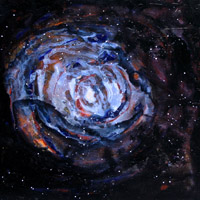
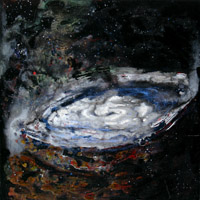
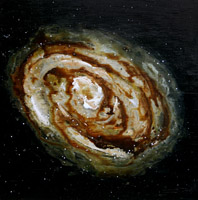
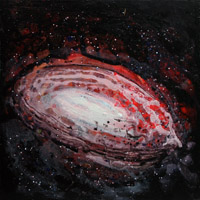
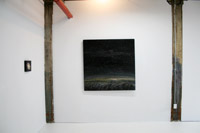
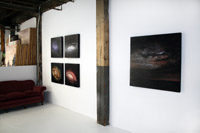
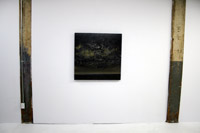
DEEP FIELD

To Purchase Work / Ask Questions:
Contact Gareth

Date: April 09 - Ongoing
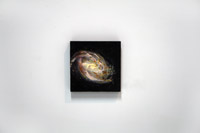
Medium: Acrylic on wood
Exhibition: This work has not yet been shown.

Artist Statement
You are a grain of sand.

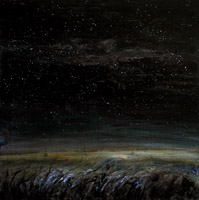
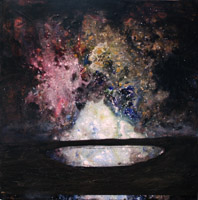
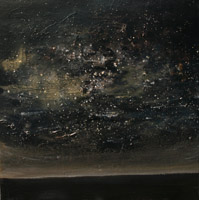
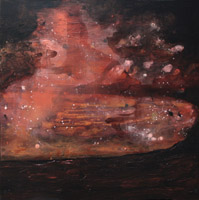
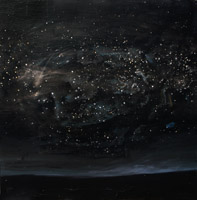
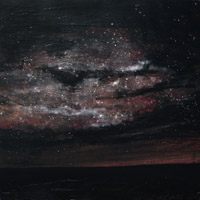
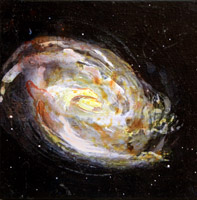
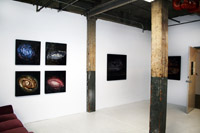
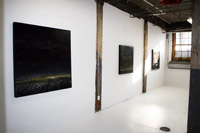
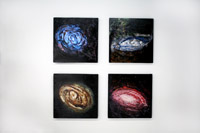
The ongoing Deep Field painting series is a meditation on our ultimate scale in the universe. It is about vanity and perspective, a contemplation of the micro and macro. We are miniscule in an incomprehensibly large and lonely universe, yet we consider ourselves supremely important.

Deep Field is inspired by the photograph known as the “Hubble Ultra Deep Field” taken by the Hubble Space Telescope. For 18 days it shot a long exposure of a section of sky that appeared completely empty. The result was astonishing. At first the image appears to be filled with stars. On closer inspection one realizes that these are in fact thousands of GALAXIES! Every galaxy contains millions of stars, many of which are just like our sun and could have orbiting planets.  It is estimated that the universe contains about125 billion galaxies.

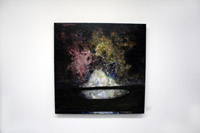
The series features a combination of cosmos paintings of the vastness of space, intermixed with paintings of stormy skies over windy fields. The two subjects sit side by side and meld together, our world and the other. The storm fields are not based on a specific place, they are archetypal fields. Rather than epic scale works, these paintings are small and intimate, yet they depict vastness and infinity. Imagery emerges from flowing and pooling paint, as if without intervention.

The relationships between people and the environment, culture and nature, and a search for personal meaning are principle themes in Gareth's artwork. It addresses the spiritual in a naturalistic worldview.

Carl Sagan in Pale Blue Dot: "Consider again that dot. That's here. That's home. That's us. On it everyone you love, everyone you know, everyone you ever heard of, every human being who ever was, lived out their lives. The aggregate of our joy and suffering, thousands of confident religions, ideologies, and economic doctrines, every hunter and forager, every hero and coward, every creator and destroyer of civilization, every king and peasant, every young couple in love, every mother and father, hopeful child, inventor and explorer, every teacher of morals, every corrupt politician, every "superstar," every "supreme leader", every saint and sinner in the history of our species lived there-on a mote of dust suspended in a sunbeam.

The earth is a very small stage in a vast cosmic arena. Think of the rivers of blood spilled by all those generals and emperors so that, in glory and triumph, they could become the momentary masters of a fraction of a dot. Think of the endless cruelties visited by the inhabitants of one corner of this pixel on the scarcely distinguishable inhabitants of some other corner, how frequent their misunderstandings, how eager they are to kill one another, how fervent their hatreds.

Our posturings, our imagined self-importance, the delusion that we have some privileged position in the Universe, are challenged by this point of pale light. Our planet is a lonely speck  in a great enveloping cosmic dark. In our obscurity, in all this vastness, there is no hint that help will come from elsewhere to save us from ourselves.

The Earth is the only world known so far to harbor life. There is nowhere else, at least in the near future, to which our specied could migrate. Visit, yes. Settle, not yet. Like it or not, for the moment the Earth is where we make our stand.

It has been said that astronomy is a humbling and character-building experience. There is perhpas no better demonstration of the folly of human conceits that this distant image of our tiny world. To me, it underscores our responsibility to deal more kindly with one another, and to preserve and cherish the pale blue dot, the only home we've ever known."